Along with the cars were several trucks, including this early 50's vintage Chevy pickup. Many of these trucks had the white-painted bumpers, grill and hubcaps from the factory, as back then most pickups were no-nonsense farm and work trucks.Sunday, May 8, 2011
ANTIQUE CAR SHOW PT4
Along with the cars were several trucks, including this early 50's vintage Chevy pickup. Many of these trucks had the white-painted bumpers, grill and hubcaps from the factory, as back then most pickups were no-nonsense farm and work trucks.ANTIQUE CAR SHOW PT3
Among the other cars whose builders no longer exist was this 1931 Auburn sedan. During the 20's and early 30's, Auburn was one of the top luxury cars in the world, along with Duesenburg and Cadillac, but the company didn't survive the Great Depression.ANTIQUE CAR SHOW PT2
Another oldie was this Earl, built during the early '20s.
The informational plaque on the front of the car. During this time period, many cars were built by individuals, some of whose names still grace the fronts of todays cars -Ford, Chevrolet and Dodge are three of them.ANTIQUE CAR SHOW PHOTOS PT1
There was an antique car show here in Lynchburg this past weekend featuring about 100 cars covering the first eight decades of the 20th century! While I only shot a relative hand full, I did get a decent cross-section of what was there.
These shots are of an early car, a Rambler. Those are solid-rubber tires. Note also the carriage lights on the front.
The rear of the car, with another carriage light. If it looks like a stagecoach on wheels, that's because that's basically what it is! In the early days, many automobiles were built by the same companies that built stagecoaches; until Henry Ford created the assembly line, they were all built by hand. And while it does have a windshield, it has drop-down curtains instead of side windows!
These shots are of an early car, a Rambler. Those are solid-rubber tires. Note also the carriage lights on the front.
The rear of the car, with another carriage light. If it looks like a stagecoach on wheels, that's because that's basically what it is! In the early days, many automobiles were built by the same companies that built stagecoaches; until Henry Ford created the assembly line, they were all built by hand. And while it does have a windshield, it has drop-down curtains instead of side windows!Friday, March 18, 2011
NS SD40-2's
On a recent visit to the NS' Montview yard...
NS SD40-2 6133 is a former Norfolk & Western locomotive. While the first order of N&W 40-2's had the normal high short-hoods, the rest fleet came with the standard short-hood seen here.
In addition to the rusted battery box (a common trait of the SD40-2 over time), notice that this unit has also had its snowplow removed! Meanwhile, the ex-Southern unit in front still has its front snowplow ( on ex-Southern units, the long hood is the front).
The ex-Southern unit also still has its distinctive high hood, with a second set of air horns on top, another Southern trait. Notice also that both railroads placed the bell on the top end of the long hood to prevent it from clogging up with snow -even though most Southern engines rarely encountered it in the Deep South!
Who says you can't run double-stacks in a general freight train? Actually, these stack cars were part of a bad-order set-out, and the string of tank cars is being used as a 'handle' to spot them on the repair track.
This was one of the two engines working Montview Yard -an ex-Burlington Northern/BNSF SD40-2 now working in lease service with CEFX reporting marks. While similar to recent Kato offerings, be aware that this engine has had its headlight relocated to the nose, a modification BNSF has been making on many of its engines.
NS SD40-2 6133 is a former Norfolk & Western locomotive. While the first order of N&W 40-2's had the normal high short-hoods, the rest fleet came with the standard short-hood seen here.
In addition to the rusted battery box (a common trait of the SD40-2 over time), notice that this unit has also had its snowplow removed! Meanwhile, the ex-Southern unit in front still has its front snowplow ( on ex-Southern units, the long hood is the front).
The ex-Southern unit also still has its distinctive high hood, with a second set of air horns on top, another Southern trait. Notice also that both railroads placed the bell on the top end of the long hood to prevent it from clogging up with snow -even though most Southern engines rarely encountered it in the Deep South!
Who says you can't run double-stacks in a general freight train? Actually, these stack cars were part of a bad-order set-out, and the string of tank cars is being used as a 'handle' to spot them on the repair track.
This was one of the two engines working Montview Yard -an ex-Burlington Northern/BNSF SD40-2 now working in lease service with CEFX reporting marks. While similar to recent Kato offerings, be aware that this engine has had its headlight relocated to the nose, a modification BNSF has been making on many of its engines.Saturday, September 11, 2010
CIRCUS TRAIN PT 3
More from this morning's circus train...
While photographing the circus train, I found this CSX SD70MAC sitting in the yard. This was one of the last EMD SD70MAC's built before a newer, more fuel-efficient model replaced it. Finding 'foreign' power in NS' Montview Yard is nothing new. Several years ago, a Rio Grande SD50 spent several days here, moving back and forth between Montview and Kinney Yards. I have also seen a Kansas City Southern SD70Ace -the successor to the SD70MAC -here as well.
A Mack CH tractor with a trailer loaded with fencing and entrance gates.
The only truck tractor I saw that was NOT a Mack, this Crane Carrier Corporation (CCC) tractor was hooked up to a ride trailer. I wonder if the CCC truck was military surplus?
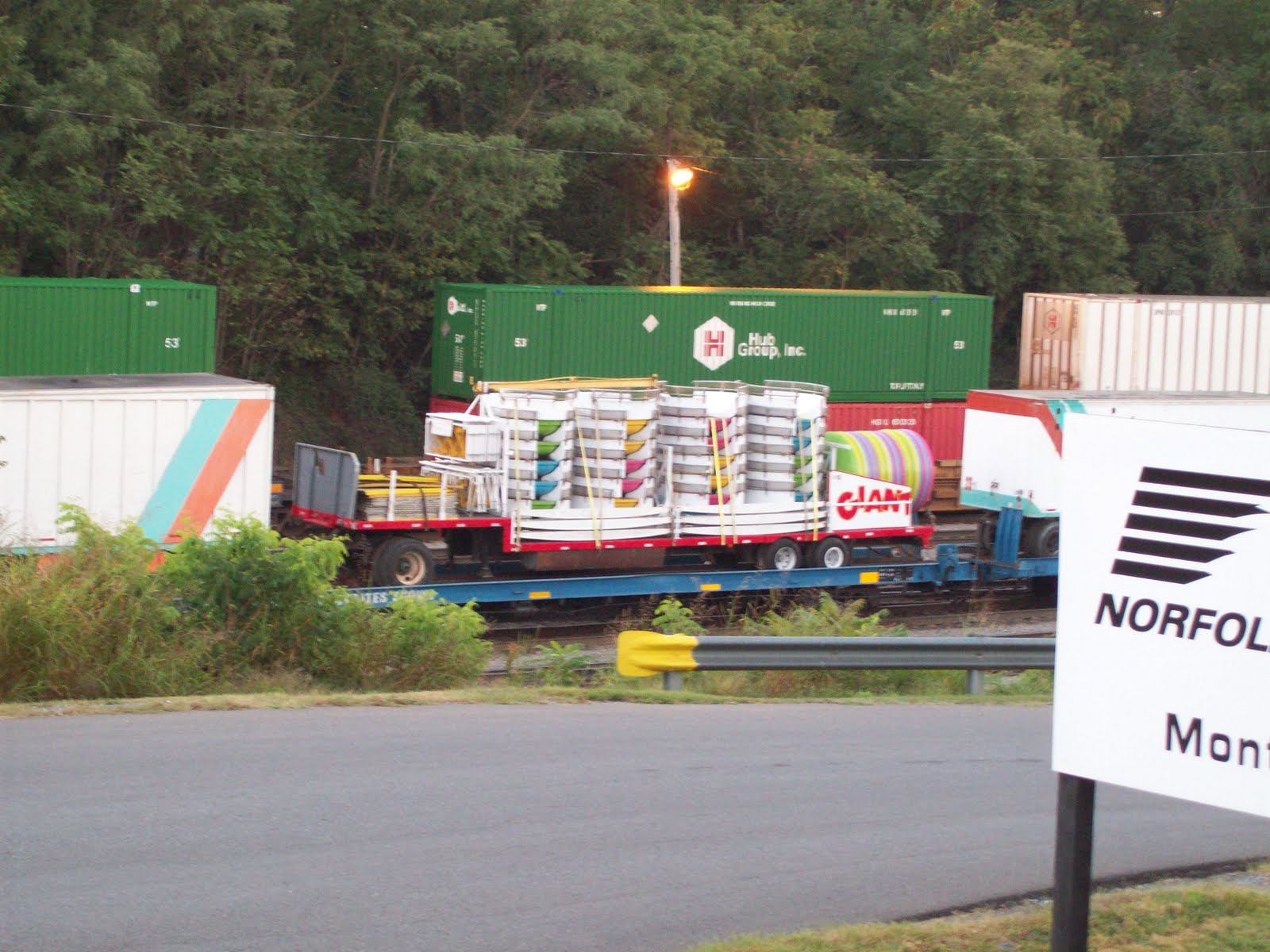
Another stowed ride on a trailer, this one with a dolly attached to the colorful trailer in front of it. In fact, it was the bright colors of the trailers which caught my eye as I was walking home from work! Also notice the fold-down ramp in front of the trailer behind the sign. There is another ramp on the rear of the flatcar, opposite corner, to allow the equipment to be driven on and off. I believe that James E Strates is the last major circus in North America to move it's equipment by train; given the size of the train, and the amount of equipment it's carrying, utilizing the rails makes sense!
While photographing the circus train, I found this CSX SD70MAC sitting in the yard. This was one of the last EMD SD70MAC's built before a newer, more fuel-efficient model replaced it. Finding 'foreign' power in NS' Montview Yard is nothing new. Several years ago, a Rio Grande SD50 spent several days here, moving back and forth between Montview and Kinney Yards. I have also seen a Kansas City Southern SD70Ace -the successor to the SD70MAC -here as well.
One of the farm tractors used to help set up, with a ride or concession stand behind it, and a trailer that appears to be loaded with ticket booths in front of it.
A Mack CH tractor with a trailer loaded with fencing and entrance gates.
The only truck tractor I saw that was NOT a Mack, this Crane Carrier Corporation (CCC) tractor was hooked up to a ride trailer. I wonder if the CCC truck was military surplus?
Another stowed ride on a trailer, this one with a dolly attached to the colorful trailer in front of it. In fact, it was the bright colors of the trailers which caught my eye as I was walking home from work! Also notice the fold-down ramp in front of the trailer behind the sign. There is another ramp on the rear of the flatcar, opposite corner, to allow the equipment to be driven on and off. I believe that James E Strates is the last major circus in North America to move it's equipment by train; given the size of the train, and the amount of equipment it's carrying, utilizing the rails makes sense! CIRCUS TRAIN PT 2
More photos of this morning's circus train...
A shot of one of the rides, folded and stored for transport. The 28' pup trailers on the next flat actually were hooked together and to the tractor as they would be on the road. For those looking to build HO scale models of them, adding the roof hatches and underbelly storage boxes to a set of Herpa/Con-Cor pups should make a very close replica. The ride trailer, however may take a little more effort.
Another interesting pair of trailers, especially the one on the right. Notice that they are hooked up to each other.
I believe that this is the end car, with the ramps used to load/unload the train. The tractor would then be used to help move the heavy ramps into position. The yellow devices are probably used to support the ramps when in use.
Both of these trailers were converted from old shipping containers. Like most of the trailers, they both have dollies at the front so that several trailers can be moved at once by one tractor to save time setting up. And, like most of the trailers, they are hooked up together on the flatcar they share. As I said before, there were several of those Mack "R" tractors among the trailers.
Subscribe to:
Posts (Atom)